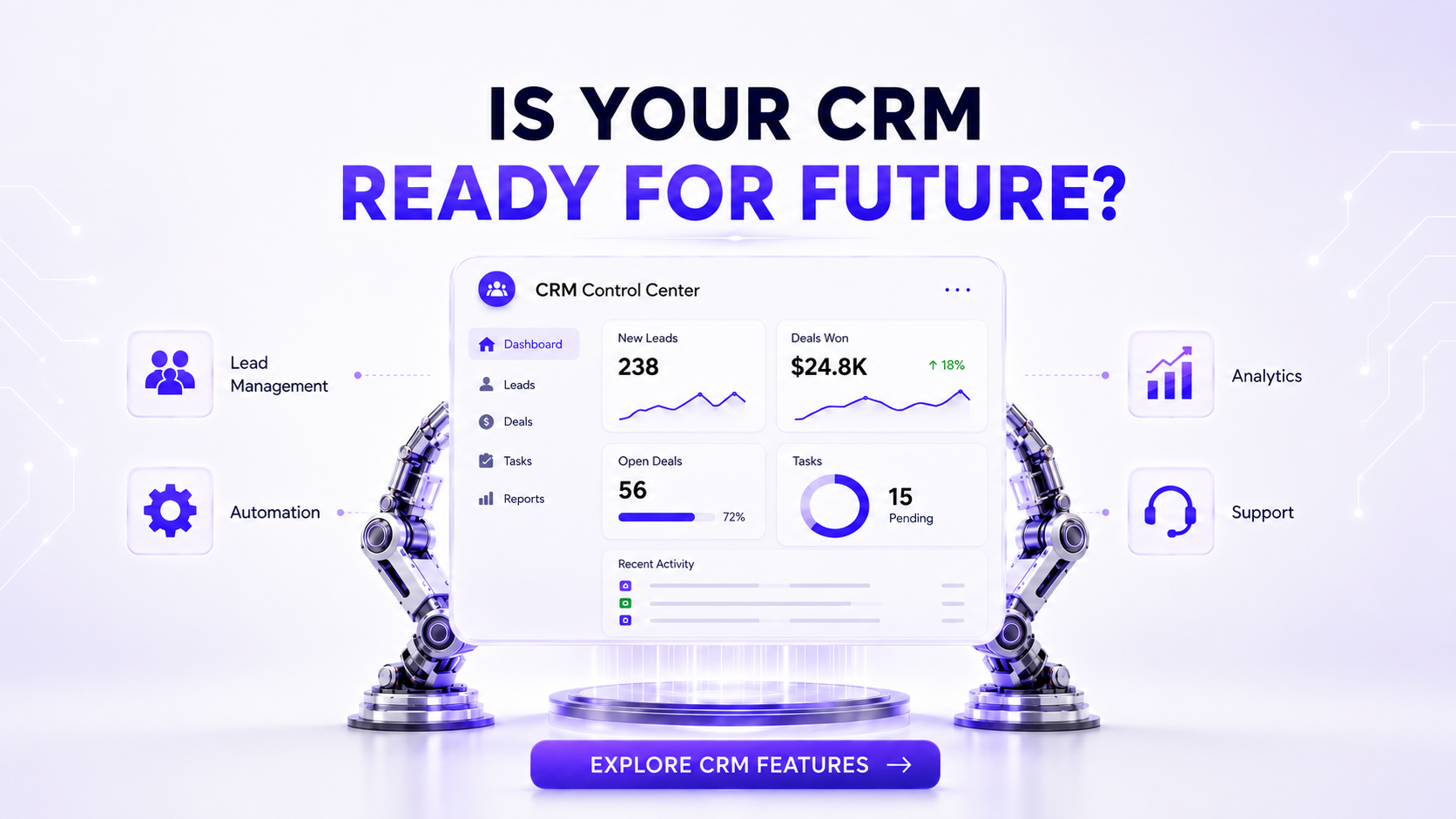
Small businesses are becoming more digital, more customer-focused and more dependent on fast decision-making. In 2026, a CRM is no longer just a place to store customer names and phone numbers. It has become a complete system that helps businesses manage leads, follow-ups, sales, communication, support and customer relationships from one place.
For small businesses, choosing the right CRM can directly impact growth. The right CRM helps teams save time, reduce manual work, avoid missed leads and build stronger customer relationships. But with so many options available, the real question is: what features should a small business actually look for in 2026?
Let’s explore the most important CRM features that can help small businesses grow smarter and faster.
1. Easy Lead Management
Lead management is one of the most important CRM features for small businesses. Every enquiry, website form submission, WhatsApp message, call or social media lead should be captured and organized properly.
A good CRM should help businesses track where each lead came from, what the customer is interested in, who is handling the lead and what the next follow-up step is. This makes sure no opportunity is missed.
In 2026, small businesses should look for a CRM that can automatically capture leads from multiple channels and assign them to the right team member. This saves time and improves response speed.
2. Sales Pipeline Tracking
A sales pipeline gives a clear view of where each deal stands. Instead of guessing which customer may convert, businesses can see every stage clearly — new lead, contacted, proposal sent, negotiation, won or lost.
For small businesses, this feature is very useful because it helps owners and sales teams understand their monthly sales progress. It also shows which deals need attention and which team members are performing well.
A CRM with a visual sales pipeline makes sales management simple, even for non-technical users.
3. Follow-Up Reminders and Task Automation
Many sales are lost not because the customer is not interested, but because the team forgets to follow up on time. This is where CRM automation becomes powerful.
A CRM should allow businesses to set reminders for calls, meetings, quotations, payment follow-ups and customer check-ins. Even better, it should automate repetitive tasks such as sending follow-up emails, assigning leads, updating statuses or notifying team members.
In 2026, automation is a must-have CRM feature for small businesses because it reduces manual work and improves consistency.
4. AI-Powered Assistance
Artificial Intelligence is becoming a major part of modern CRM systems. Small businesses should look for CRM tools that offer simple and practical AI features.
AI can help suggest the best time to contact a lead, summarize customer conversations, recommend next actions, write email drafts, analyze sales data and identify high-priority leads.
For small businesses, AI should not feel complicated. It should work like a smart assistant that helps the team make better decisions and save time.
5. WhatsApp and Email Integration
Customers today communicate through multiple platforms. For many small businesses, WhatsApp is one of the most important communication channels.
A CRM in 2026 should support integration with WhatsApp, email, phone calls, website forms and social media platforms. This helps businesses keep all customer conversations in one place.
When communication history is stored inside the CRM, any team member can understand the customer journey without asking for repeated details. This improves customer experience and builds trust.
6. Customer Data in One Place
Small businesses often struggle because customer information is scattered across notebooks, Excel sheets, phones, emails and chat apps. A CRM solves this problem by keeping all customer data in one centralized system.
A good CRM should store contact details, enquiry history, purchase history, communication records, documents, notes, invoices and support tickets.
This gives the business a complete view of every customer. It also helps the team provide more personalized and professional service.
7. Reporting and Analytics
Business owners need clear reports to understand what is working and what needs improvement. A CRM should provide useful dashboards and reports without making the process complicated.
Important CRM reports include lead source performance, sales conversion rate, team performance, pending follow-ups, revenue forecast, lost deal reasons and customer activity.
In 2026, data-driven decisions will become even more important for small businesses. A CRM with simple analytics can help owners plan better and grow faster.
8. Mobile CRM Access
Small business teams are often on the move. Sales executives, service teams, field staff and business owners need access to customer data anytime and anywhere.
A mobile-friendly CRM allows users to check leads, update deal status, add notes, call customers and manage tasks directly from their phones.
This is especially useful for businesses where team members work outside the office or handle customer meetings in different locations.
9. Marketing Automation
CRM is not only for sales. It should also help with marketing.
Small businesses should look for features like email campaigns, customer segmentation, automated messages, lead nurturing and campaign tracking. These features help businesses stay connected with prospects and existing customers.
For example, a CRM can automatically send welcome emails to new leads, reminders to inactive customers or offers to repeat buyers. This improves engagement without increasing manual effort.
10. Customer Support and Ticket Management
Customer service plays a big role in business growth. A CRM should help businesses manage customer complaints, service requests and support tickets in an organized way.
Support ticket management helps the team track issues from start to resolution. It also ensures that customer problems are not ignored or delayed.
For small businesses, this feature improves professionalism and helps build long-term customer loyalty.
11. Customization Options
Every small business works differently. A real estate company, logistics company, digital agency, education institute and service provider will not have the same sales process.
That is why CRM customization is important. Businesses should be able to customize fields, stages, forms, workflows, reports and user roles according to their needs.
A CRM should adapt to the business process, not force the business to change its working style completely.
12. User-Friendly Interface
Small businesses do not always have technical teams to manage complicated software. A CRM should be simple, clean and easy to use.
If the CRM is too complex, the team may avoid using it. The best CRM is one that employees can understand quickly and use daily without confusion.
In 2026, ease of use will be one of the biggest factors for CRM success in small businesses.
13. Integration With Other Business Tools
A CRM becomes more powerful when it connects with other tools used by the business. This may include accounting software, invoicing tools, payment gateways, website forms, email platforms, calling systems and marketing tools.
Integrations reduce duplicate work and help data flow smoothly between departments. For small businesses, this creates a more connected and efficient workflow.
14. Role-Based Access and Data Security
Customer data is valuable. A CRM should protect this data with proper security features.
Small businesses should look for role-based access, secure login, data backup, activity logs and permission controls. This ensures that only authorized team members can access sensitive information.
As businesses grow, data security becomes even more important.
15. Scalability for Future Growth
A CRM should not only solve today’s problems. It should also support future growth.
Small businesses should choose a CRM that can handle more users, more customers, more automation and more advanced features as the business expands.
A scalable CRM helps businesses avoid switching systems again and again.
Final Thoughts
In 2026, the best CRM for small businesses will be the one that combines simplicity, automation, AI, customer data, sales tracking and communication in one place.
Small businesses should not choose a CRM only because it has many features. They should choose a CRM that matches their business process, is easy for the team to use and helps improve customer relationships.
The right CRM can help small businesses manage leads better, close more deals, improve customer service and make smarter decisions. In a competitive market, CRM is no longer optional — it is a growth tool every small business should seriously consider.