
Introduction
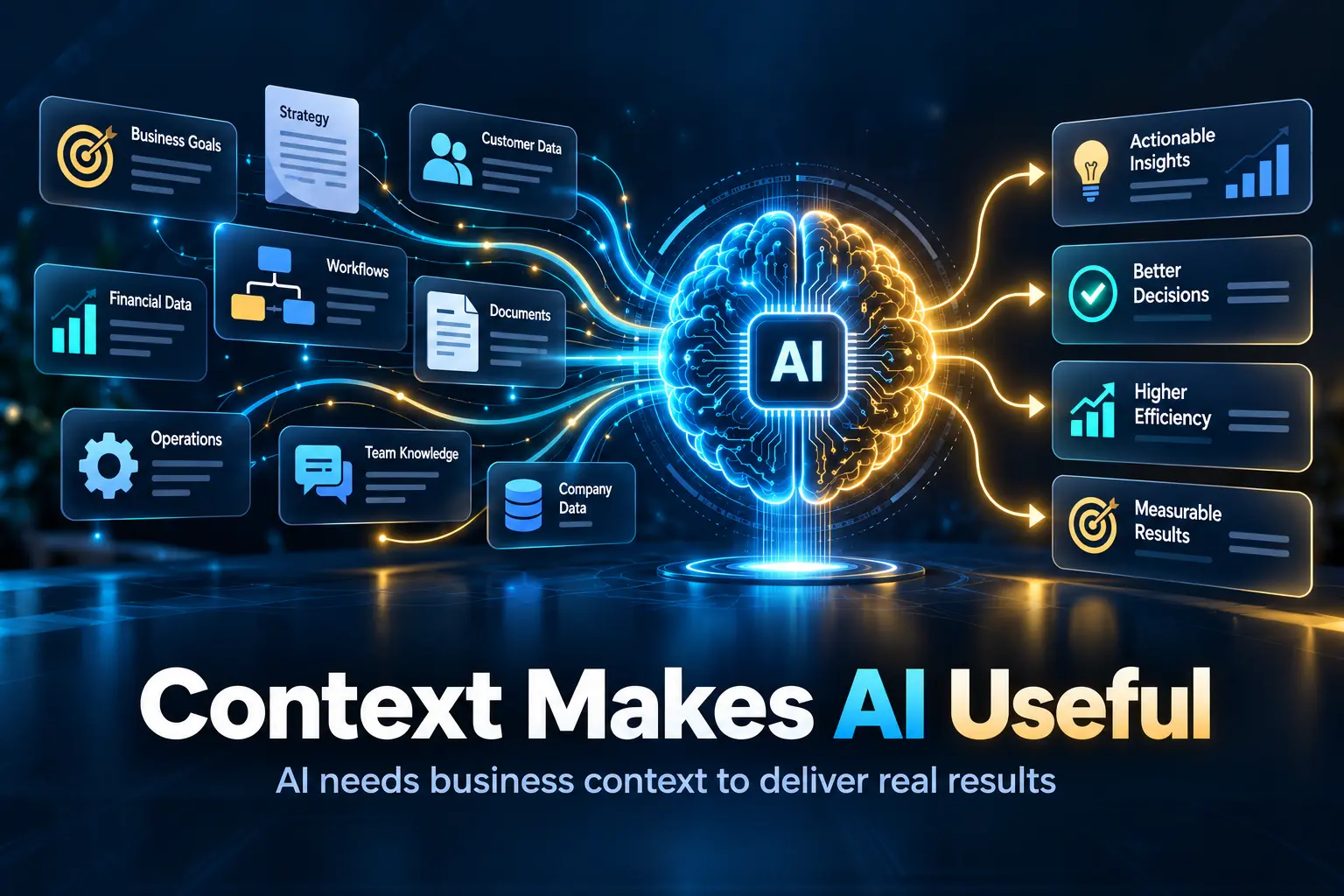
Artificial intelligence can generate answers, analyse data, and automate tasks in seconds. But even the most advanced AI tools can deliver disappointing results when they lack one important ingredient: business context.
Understanding a question is not the same as understanding a business. To provide useful recommendations, AI needs information about a company’s goals, customers, workflows, priorities, and challenges.
Without this context, AI may produce technically correct answers that simply don’t fit the situation.
What Is Business Context in AI?
Business context refers to the information that helps AI understand how a business operates and what it wants to achieve.
This can include customer records, sales history, ongoing projects, employee responsibilities, company policies, and business objectives.
For example, a generic AI tool might suggest sending follow-up emails to every potential customer. However, an AI system with relevant business context could prioritise high-value leads, consider previous interactions, and recommend an appropriate follow-up schedule.
The difference lies in how well AI understands the situation behind the task.
Why Business Context Matters for AI
1. More Relevant and Accurate Results
AI produces more useful recommendations when it has access to reliable, relevant information. Understanding business goals and customer preferences helps it provide responses that align with actual requirements rather than generic assumptions.
2. Better Decision-Making
Business decisions often depend on multiple factors, including budgets, deadlines, customer behaviour, and available resources.
With the right context, AI can analyse these factors together and support more informed decisions.
3. Smarter Workflow Automation
AI-powered automation becomes more effective when it understands how tasks connect.
For instance, a CRM workflow can use lead status, previous interactions, and follow-up deadlines to help sales teams prioritise their next actions instead of treating every lead equally.
4. Consistency Across Teams
When information is scattered across spreadsheets, emails, and disconnected tools, employees may work with incomplete or outdated data.
Centralised business information can help AI-powered systems deliver more consistent insights and support smoother collaboration.
The Role of Connected Business Management Platforms
AI needs more than a powerful model to deliver meaningful business value. It also needs access to the right information, reliable integrations, and clearly defined workflows.
This is where business management platforms become important.
Platforms like Rimacle bring together lead management, task and project management, automation, documentation, and employee management. Organising these activities in one environment can help businesses maintain better visibility into their operations and establish a stronger foundation for AI adoption.
When business information is structured and accessible through appropriate integrations, AI can provide insights that are more relevant to real business needs.
How Businesses Can Prepare for Context-Aware AI
Businesses can take a few practical steps to improve the usefulness of AI:
- Organise business data: Maintain accurate, updated, and structured records.
- Connect essential tools: Reduce information gaps between business applications.
- Define clear goals: Help AI understand the outcomes the business wants to achieve.
- Establish workflows: Document processes, responsibilities, and approval requirements.
- Protect sensitive information: Apply appropriate access controls and privacy safeguards.
These steps help create the conditions for AI to deliver more relevant and dependable results.
Conclusion
AI can generate information quickly, but useful business outcomes require more than speed. They depend on understanding the company’s goals, customers, processes, and priorities.
Business context transforms AI from a general-purpose tool into a more relevant source of insights and operational support.
For growing businesses, the next step in AI adoption is not simply using more AI tools. It is ensuring those tools have access to the right information, within the right boundaries, to support better decisions.
Because AI delivers its greatest value when it understands not just what a business asks, but why it matters.