
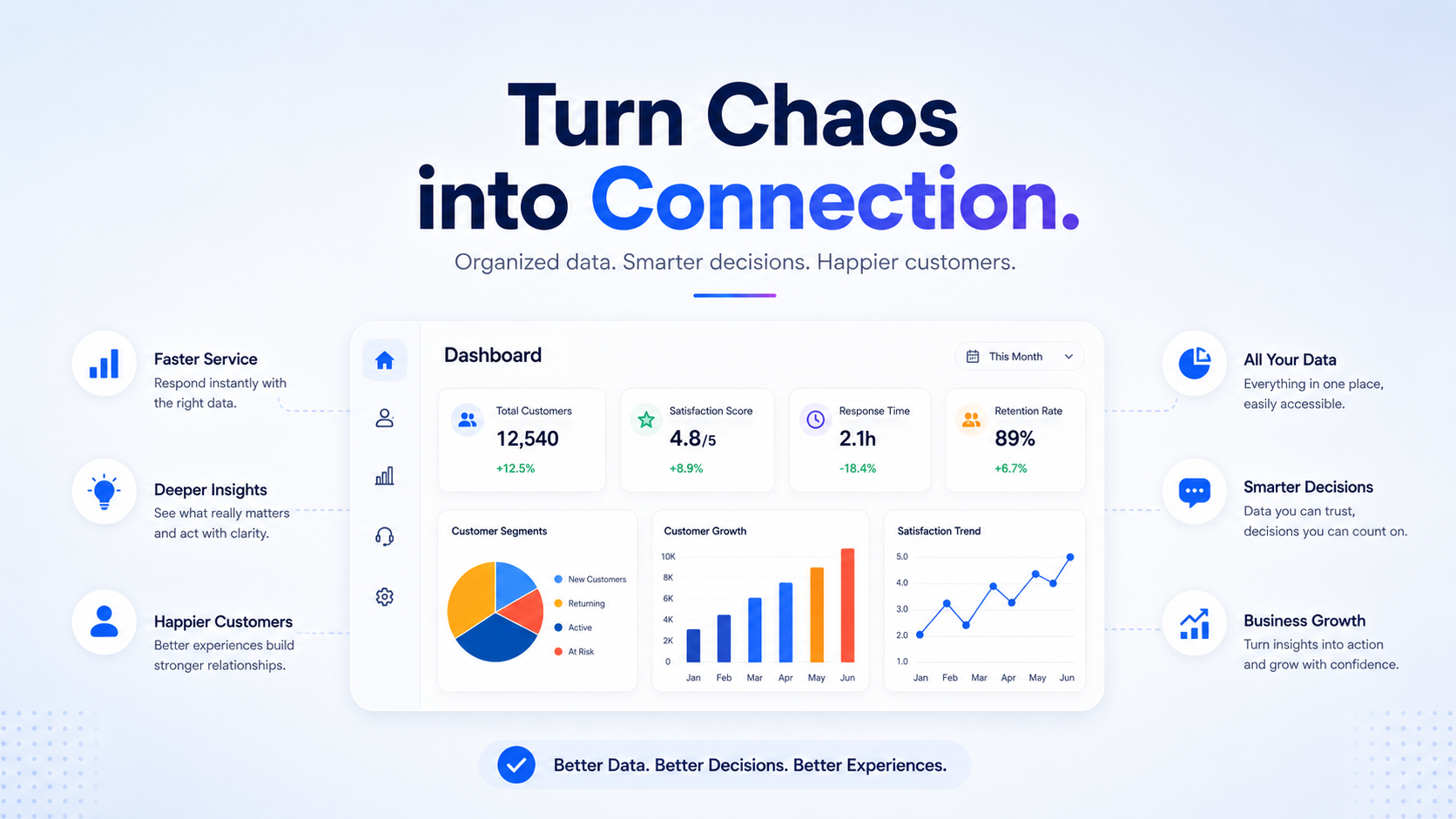
Customer experience is one of the most important factors behind business growth. Customers today expect quick responses, personalized communication, accurate information and smooth service at every step. But to deliver this experience, businesses need one important foundation: well-organized data.
When customer data is scattered across Excel sheets, emails, WhatsApp chats, notebooks, CRM tools and different departments, it becomes difficult to understand customers properly. Teams waste time searching for information, customers have to repeat the same details and service quality becomes inconsistent.
Better data organization helps businesses solve these problems. It gives teams easy access to the right information at the right time. As a result, businesses can respond faster, personalize communication and deliver a more professional customer experience.
What Is Data Organization?
Data organization means arranging business and customer information in a clear, structured and accessible way. It includes storing customer details, enquiries, purchase history, communication records, documents, support tickets, follow-ups and payment information in one proper system.
Instead of keeping information in multiple disconnected places, organized data gives businesses a complete view of every customer. This helps teams work better and customers receive smoother service.
Why Data Organization Matters for Customer Experience
Customer experience depends on how easily a business can understand and serve its customers. If the team does not have proper customer information, they may give delayed responses, incorrect updates or repeated questions.
When data is organized, every team member can quickly see who the customer is, what they need, what communication has happened before and what action is required next.
This creates a faster, smarter and more reliable customer experience.
1. Faster Customer Response
Customers do not like waiting for answers. Whether they are asking about a product, service, order, payment or complaint, they expect quick support.
Organized data helps teams find customer information instantly. They do not need to search through old messages, files or multiple systems. With all details available in one place, teams can respond faster and more confidently.
Fast response improves customer satisfaction and creates a strong first impression.
2. Personalized Communication
Every customer wants to feel understood. When businesses have organized customer data, they can personalize communication based on customer needs, preferences and history.
For example, a sales team can understand what product a customer enquired about earlier. A support team can check previous complaints before replying. A marketing team can send relevant offers based on past purchases.
Personalized communication makes customers feel valued and increases trust.
3. Fewer Repeated Questions
One of the most frustrating experiences for customers is having to repeat the same information again and again. This usually happens when customer data is not properly shared between teams.
With better data organization, every department can access the same customer history. Sales, support, accounts and operations can all see the required details without asking the customer repeatedly.
This creates a smoother and more professional experience.
4. Better Team Coordination
Customer experience is not handled by one person only. It often involves multiple teams such as sales, support, billing, delivery and management.
If these teams do not have access to organized information, communication gaps can happen. One team may not know what the other team promised or updated.
Organized data keeps everyone aligned. It helps teams understand customer status, pending tasks, follow-ups and responsibilities clearly. This improves internal coordination and reduces mistakes.
5. More Accurate Information
Incorrect information can damage customer trust. If a customer receives the wrong price, wrong order status, wrong payment update or wrong service information, it can create confusion and dissatisfaction.
Better data organization reduces these errors. Since all information is stored in a structured system, teams can access accurate and updated details before communicating with customers.
Accurate information builds confidence and improves the overall customer relationship.
6. Improved Follow-Ups
Many customer opportunities are lost because follow-ups are missed. A customer may enquire today and expect a call tomorrow, but if that reminder is not tracked properly, the lead can be lost.
Organized data helps businesses track follow-up dates, customer interest, deal stage and next action. CRM systems can also send reminders to the team so no customer is ignored.
Timely follow-ups show professionalism and increase the chances of conversion.
7. Faster Complaint Resolution
Customer complaints need quick and proper handling. If complaint details are not recorded properly, the issue may get delayed or repeated.
With organized data, support teams can track complaints from start to resolution. They can see when the complaint was raised, who is handling it, what action has been taken and whether the issue is resolved.
This helps businesses solve problems faster and improves customer satisfaction.
8. Better Customer Insights
Organized data helps businesses understand customer behavior. It can show what customers are buying, which services they prefer, what problems they face and where they need support.
These insights help businesses make better decisions. They can improve products, update services, plan marketing campaigns and identify customer needs more clearly.
Better insights lead to better customer experience.
9. Consistent Customer Service
Customers expect the same quality of service every time they interact with a business. But if data is not organized, service quality may depend on which team member is handling the customer.
Organized data creates consistency. Any team member can check customer history and continue the conversation smoothly.
This is especially useful when employees are absent, teams change or customers interact with different departments.
10. Stronger Customer Relationships
When a business remembers customer details, responds on time and provides accurate support, customers develop trust.
Better data organization helps businesses build stronger long-term relationships. Customers feel that the business understands them and cares about their needs.
This increases customer loyalty and repeat business.
Role of CRM in Data Organization
A CRM system plays a major role in organizing customer data. It stores customer information, leads, communication history, follow-ups, sales pipeline, support tickets and reports in one place.
With CRM, businesses can avoid scattered data and manual tracking. Teams can access customer details quickly, automate reminders, manage tasks and improve communication.
For small and growing businesses, CRM makes data organization easier and more effective.
Benefits of Better Data Organization
Better data organization helps businesses improve customer experience in many ways:
- Faster response time
- Better customer understanding
- Personalized communication
- Fewer mistakes
- Improved team coordination
- Timely follow-ups
- Faster complaint resolution
- Better sales conversion
- Stronger customer loyalty
- More professional service
These benefits make data organization an important part of business growth.
Final Thoughts
Better data organization is not only about storing information properly. It is about using customer information to deliver better service, faster support and more meaningful communication.
When customer data is organized, teams work with clarity and customers get a smoother experience. Businesses can reduce delays, avoid confusion, improve follow-ups and build stronger customer relationships.
In a competitive market, customer experience can become a major advantage. Businesses that organize their data well are better prepared to understand customers, serve them faster and grow with confidence.