
Business tasks often fail for one simple reason: nobody knows exactly who is responsible, when the work should be completed or whether it is actually moving forward.
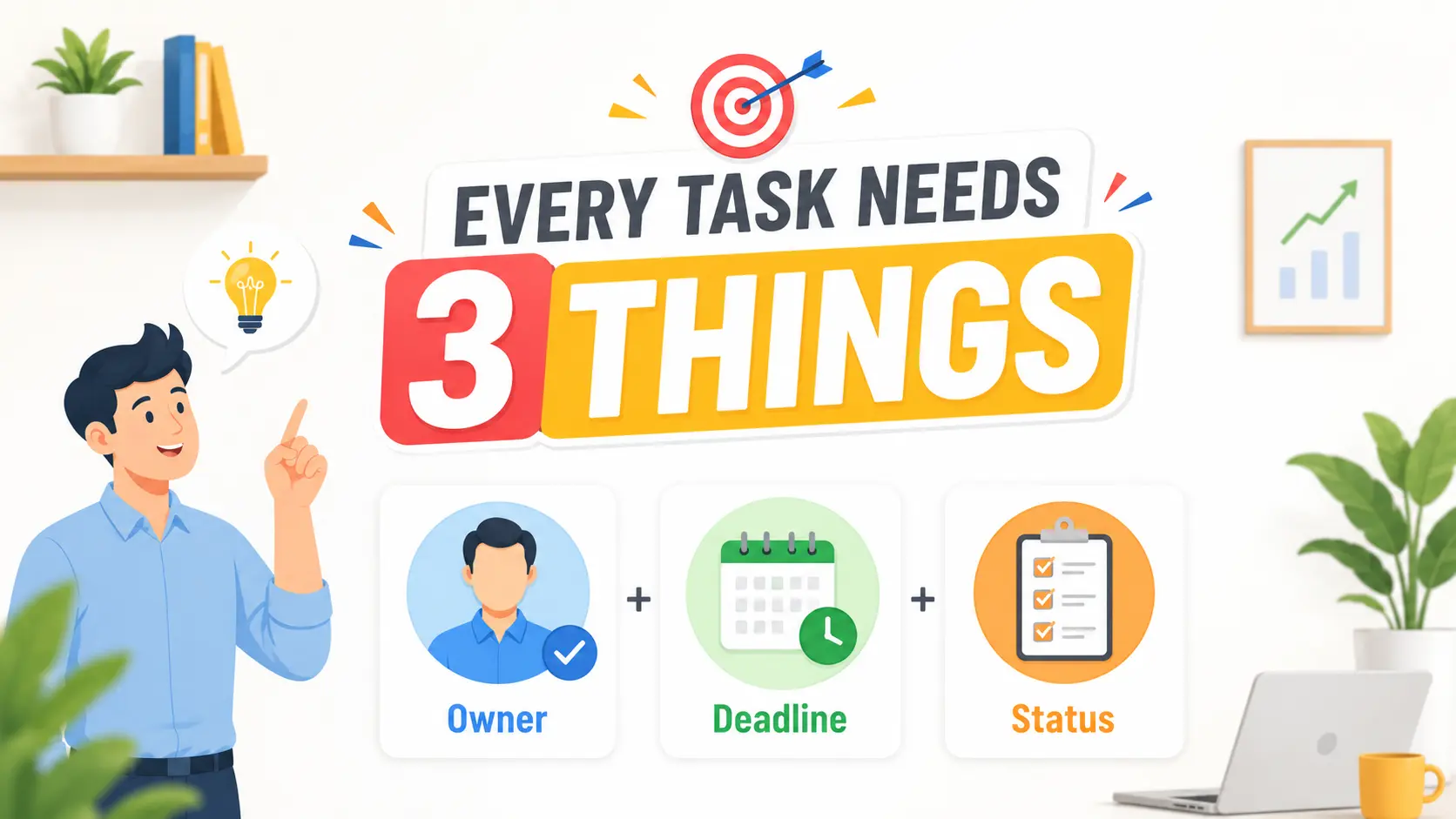
A task such as “update the client proposal” or “follow up with the supplier” may sound clear, but without proper accountability, it can easily remain unfinished. To keep work organised and projects on track, every business task should include three essential elements: an owner, a deadline and a status.
1. An Owner Creates Accountability
Every task needs one clearly assigned owner.
The owner is the person responsible for making sure the task is completed. Other team members may contribute, provide information or approve the work, but one person should remain accountable for the final outcome.
When a task has no owner, team members may assume that someone else is handling it. This creates delays, confusion and missed responsibilities.
Clear ownership helps teams answer one important question:
Who is responsible for moving this task forward?
Assigning an owner also makes communication easier. Instead of asking multiple people for updates, managers and team members know exactly whom to contact.
2. A Deadline Creates Urgency and Priority
A task without a deadline can remain pending for days or even weeks.
Deadlines help employees understand when work is expected and how it should be prioritised compared with other responsibilities. They also allow teams to plan workloads, coordinate dependencies and avoid last-minute pressure.
For example, if a design task must be completed before a marketing campaign launches, the deadline should reflect when the campaign team actually needs the final design.
A realistic deadline should be:
- Clear and specific
- Based on the task’s complexity
- Aligned with related activities
- Visible to everyone involved
Deadlines should not simply create pressure. Their purpose is to create clarity and support better planning.
3. A Status Shows Real-Time Progress
Assigning a task is not enough. Teams also need to know what is happening after the task has been created.
A status gives everyone a quick view of the task’s current stage. Common task statuses may include:
- Not Started
- In Progress
- Waiting for Approval
- Blocked
- Completed
Without a status, managers may repeatedly ask employees for updates. Team members may also struggle to understand whether a task requires action, review or additional support.
A regularly updated status makes progress visible and reduces unnecessary follow-ups.
The Problem With Vague Task Management
Many businesses still manage tasks through scattered emails, chat messages, notebooks or verbal instructions.
This often creates questions such as:
- Who is handling the task?
- When is it due?
- Has the work started?
- Is someone waiting for approval?
- What is causing the delay?
- Has the task already been completed?
When this information is not available in one place, employees spend more time searching for updates than completing the actual work.
Vague task management can result in duplicated work, delayed projects, missed customer commitments and reduced productivity.
How These Three Elements Work Together
Ownership, deadlines and statuses are most effective when used together.
Consider the following task:
Task: Prepare the monthly sales report
Owner: Sales Executive
Deadline: 5 August
Status: In Progress
This simple structure immediately tells the team what needs to be done, who is responsible, when it is expected and how far the work has progressed.
If any one of these elements is missing, the task becomes less effective.
A task with an owner but no deadline may be delayed.
A task with a deadline but no owner may be ignored.
A task with an owner and deadline but no status may become difficult to track.
Benefits for Managers
Structured task management gives managers better visibility into daily operations.
Managers can quickly identify:
- Overdue tasks
- Employees with heavy workloads
- Tasks waiting for approval
- Repeated operational bottlenecks
- Projects at risk of delay
This allows managers to solve problems earlier rather than waiting until a deadline has already been missed.
It also reduces micromanagement. When task progress is visible, managers do not need to constantly ask employees for updates.
Benefits for Employees
Clear task information also improves the employee experience.
Employees know exactly what is expected from them, which tasks should be prioritised and when their work is due. They can manage their time more effectively and communicate early when they face a blocker.
This reduces workplace confusion and prevents employees from being blamed for tasks that were never clearly assigned.
Building a Better Task Management Process
Businesses can improve task execution by following a simple process:
- Write a clear task title and description.
- Assign one accountable owner.
- Add a realistic deadline.
- Select the correct status.
- Record important notes, files and updates.
- Review overdue and blocked tasks regularly.
- Mark tasks as completed only after the expected outcome is delivered.
Using a central task management system makes this process easier because all task information remains visible and accessible to the team.
Final Thoughts
Successful businesses do not rely on memory, assumptions or repeated follow-ups to get work completed.
Every task should clearly show who owns it, when it is due and where it currently stands. These three elements create accountability, improve communication and help teams complete work more consistently.
When ownership, deadlines and statuses become part of everyday business operations, tasks stop getting lost and teams gain greater control over their work.