
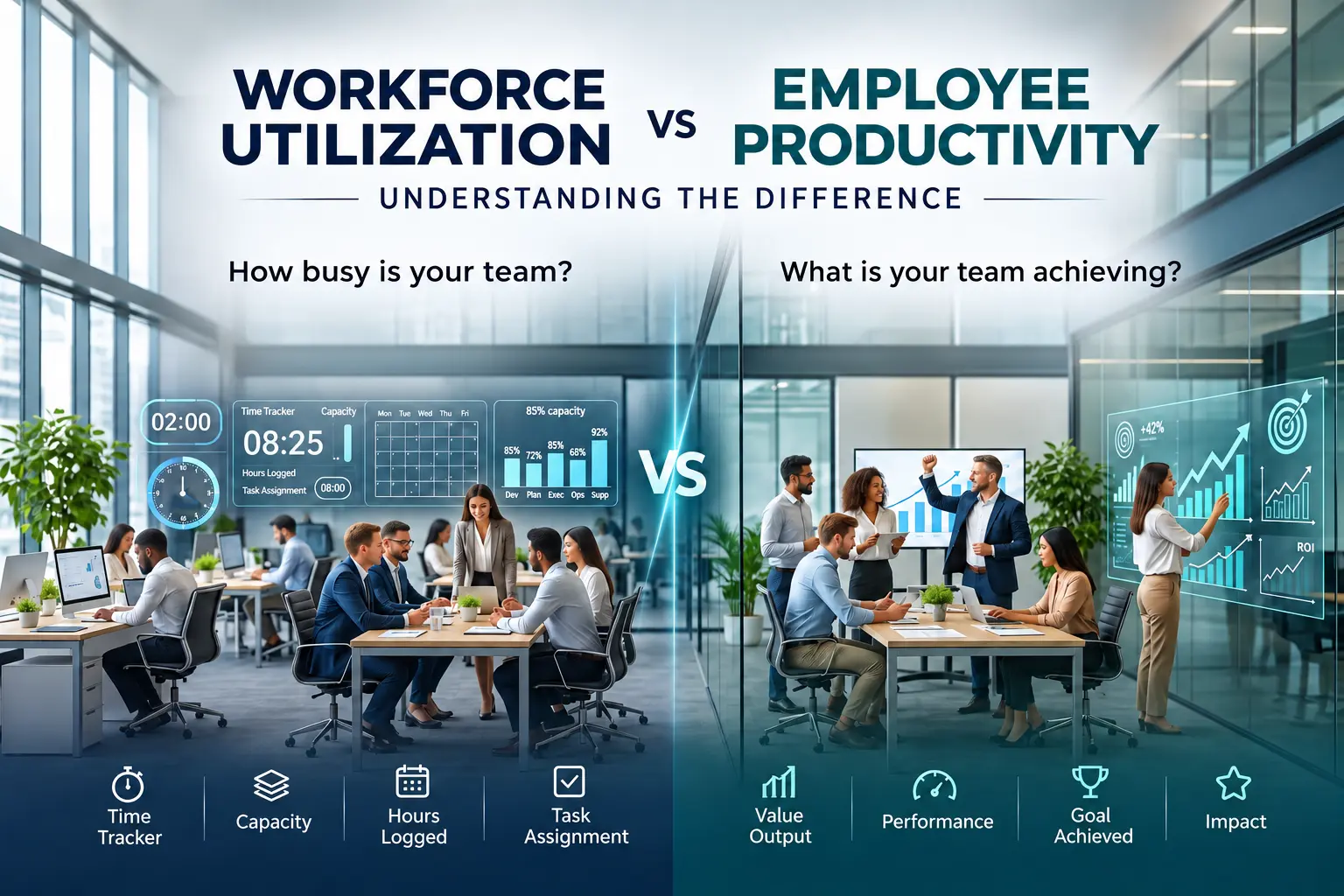
Businesses often measure employee performance through working hours, completed tasks, and overall output. However, two important concepts are frequently confused during this evaluation: workforce utilization and employee productivity.
Although both are connected to business efficiency, they measure different aspects of workforce performance. Workforce utilization focuses on how effectively employees’ available working time is being used, while employee productivity measures the value and output generated through their efforts.
Understanding this difference helps businesses identify operational inefficiencies, improve resource allocation, and build more effective teams.
What Is Workforce Utilization?
Workforce utilization refers to how much of an employee’s available working time is spent on productive, assigned, or business-related activities.
It helps organisations understand whether their employees are being used effectively and whether workloads are distributed appropriately.
For example, an employee working eight hours a day may spend six hours completing assigned projects, attending relevant meetings, and handling operational responsibilities. The remaining time may involve waiting for approvals, unnecessary meetings, or unallocated tasks.
Businesses use workforce utilization to identify idle time, workload imbalances, and resource allocation problems.
However, high utilization does not automatically mean employees are performing efficiently.
What Is Employee Productivity?
Employee productivity measures how much meaningful work or value an employee generates within a given period.
It focuses on the quality, efficiency, and outcomes of completed work rather than simply the number of hours spent working.
For example, one employee may complete ten routine tasks in a day, while another completes three complex tasks that generate greater business value.
The second employee may demonstrate higher productivity despite completing fewer tasks.
Productivity depends on several factors, including employee skills, available resources, process efficiency, technology, and clarity of responsibilities.
Why Workforce Utilization and Productivity Are Not the Same
One of the biggest mistakes businesses make is assuming that employees who remain busy throughout the day are automatically productive.
An employee may have a fully occupied schedule but spend considerable time on repetitive administrative work, unnecessary reporting, and tasks that do not directly contribute to business goals.
Similarly, an employee who completes valuable work efficiently may have some available time remaining.
This means businesses should not evaluate workforce performance through utilization rates alone.
The objective should be to ensure employees are spending their time on meaningful activities that contribute to organisational results.
How High Workforce Utilization Can Reduce Productivity
Maintaining maximum workforce utilization may appear beneficial, but constantly assigning work without considering employee capacity can create problems.
Employee Burnout: Continuous workloads without sufficient breaks or recovery time can affect employee well-being and performance.
Reduced Work Quality: When employees are constantly occupied, they may rush through assignments, increasing mistakes and rework.
Limited Innovation: Employees with no available time may struggle to explore better methods, solve problems, or develop new ideas.
Increased Operational Pressure: Overloaded teams may find it difficult to manage unexpected tasks, urgent requests, and changing business priorities.
Businesses should therefore focus on balanced utilization rather than keeping every employee occupied every minute.
How Businesses Can Improve Both Workforce Utilization and Productivity
Improving workforce performance requires more than assigning additional tasks. Organisations need to understand how work is distributed and whether employees have the right resources to complete it efficiently.
1. Evaluate Existing Workflows
Review how tasks move across departments and identify unnecessary approvals, repetitive activities, and communication delays.
Improving workflows can help employees complete responsibilities with less wasted effort.
2. Assign Tasks Based on Skills
Employees should receive responsibilities that match their experience, expertise, and capabilities.
Better task allocation reduces unnecessary delays and helps organisations make better use of available talent.
3. Reduce Repetitive Administrative Work
Manual reporting, data entry, follow-ups, and task tracking can consume significant working hours.
Using suitable software and automation can reduce these activities and allow employees to focus on higher-value responsibilities.
4. Measure Outcomes Instead of Just Working Hours
Businesses should evaluate completed projects, service quality, customer satisfaction, deadlines, and actual business results.
This provides a more meaningful understanding of employee productivity than simply tracking attendance or time spent working.
5. Monitor Workload Distribution
Regularly reviewing workloads helps management identify employees who are overloaded and others who have unused capacity.
Balanced distribution improves coordination and helps prevent unnecessary hiring.
The Role of Technology in Workforce Management
Modern business management systems can help organisations improve workforce visibility and operational efficiency.
Project management platforms help track assignments, deadlines, and project progress. CRM systems provide visibility into sales activities and customer-related responsibilities, while automation tools reduce repetitive administrative tasks.
When these systems work together, management can better understand how resources are being used and where productivity improvements are needed.
However, technology should support better management decisions rather than encourage excessive employee monitoring.
Conclusion
Workforce utilization and employee productivity are closely connected, but they are not interchangeable.
Utilization helps businesses understand how employees’ available time is being allocated, while productivity reveals the value generated through that time.
Organisations that focus only on keeping employees busy may overlook deeper operational inefficiencies.
The real objective should be to create an environment where employees have clear responsibilities, balanced workloads, efficient processes, and the right tools to perform their work.
Business efficiency is not about making every employee busy for eight hours. It is about ensuring that the time, skills, and resources available are contributing to meaningful business outcomes.